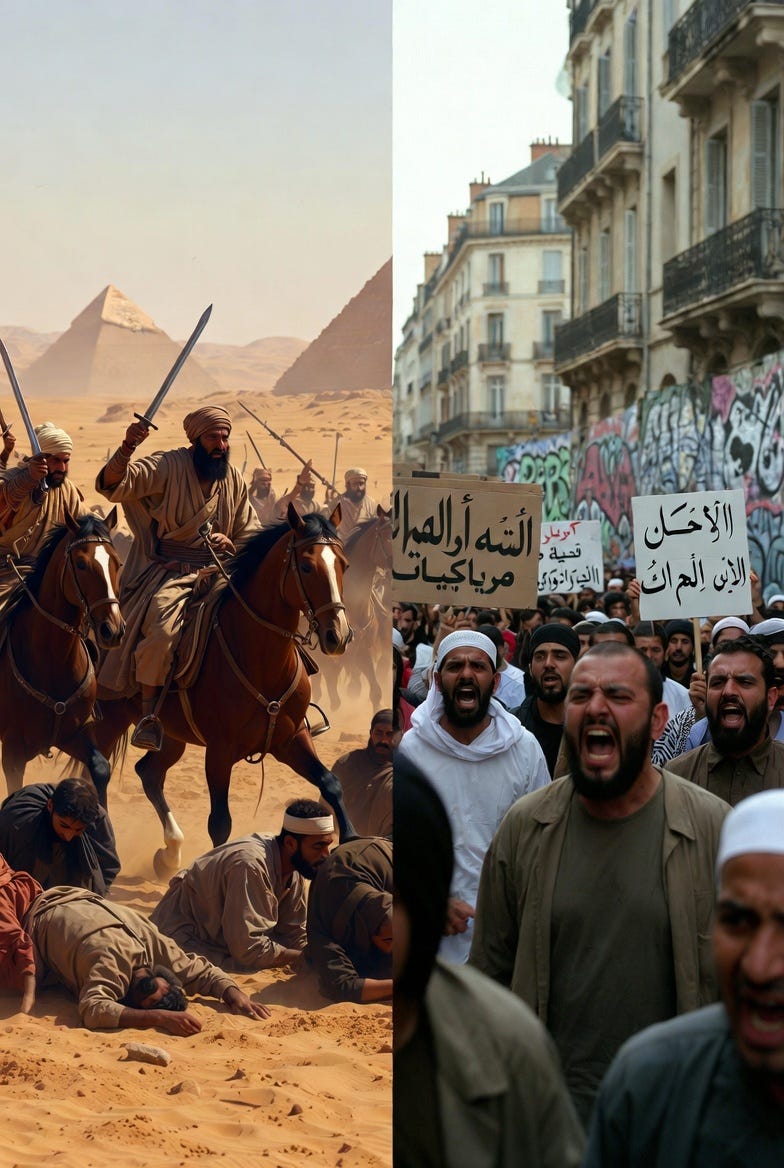
The Submission-Resistance Hypothesis
Why Islamists Demands Perpetual Conflict

The term “Islam” derives from the Arabic root *s-l-m*, meaning “submission” or “peace through surrender” to Allah. The Submission-Resistance Hypothesis posits a dual imperative inherent in Islamic doctrine: (1) Muslims must fully submit to Allah’s will as revealed in the Quran and exemplified by Muhammad’s life (the *Sunnah*), and (2) this submission necessitates active resistance against those who refuse to submit—non-Muslims (*kuffar*). This is not merely defensive but a proactive obligation to establish Allah’s sovereignty over all humanity. The hypothesis frames Islam not as a religion of personal piety alone but as a total system requiring perpetual *jihad* (struggle) against disbelief until the world is under Islamic rule. This essay explores the doctrinal, historical, and sociological reasons why Islamists—those adhering strictly to foundational texts—must maintain constant war or resistance against non-Muslims, drawing directly from primary Islamic sources.
Doctrinal Foundations
The Quran explicitly ties submission to Allah with the subjugation of non-believers. Quran 9:29 commands: “Fight those who do not believe in Allah or in the Last Day and who do not consider unlawful what Allah and His Messenger have made unlawful and who do not adopt the religion of truth from those who were given the Scripture—[fight] until they give the *jizyah* willingly while they are humbled.” Here, fighting is mandated not for self-defence but until non-Muslims pay a protection tax in humiliation, acknowledging Islamic supremacy. This verse, revealed late in Muhammad’s career (post-conquest of Mecca), abrogates earlier tolerant verses (e.g., Quran 2:256, “There is no compulsion in religion”) under the principle of *naskh* (abrogation), where later revelations override earlier ones.
Muhammad’s own actions reinforce this. In his farewell sermon, he declared: “I was ordered to fight all men until they say ‘There is no god but Allah’” (Sahih Muslim 1:33). The *Sunnah* chronicles over 80 military expeditions in Muhammad’s 10 years in Medina, targeting polytheists, Jews, and Christians who rejected his prophethood. The Treaty of Hudaybiyyah (628 CE) was a tactical truce, broken when Muslims gained strength, leading to Mecca’s conquest. Submission to Allah thus requires eliminating resistance to His rule—non-submission is an affront to divine sovereignty, making peace impossible without conversion, subjugation, or elimination.
Classical scholars like Ibn Taymiyyah (d. 1328) codified this in *Al-Siyasah al-Shar’iyyah*: Jihad is obligatory to “make Allah’s word supreme” (Quran 8:39). The world is divided into *Dar al-Islam* (House of Submission) and *Dar al-Harb* (House of War), with the latter existing in a state of perpetual hostility until absorbed. Modern Islamists, from Hassan al-Banna (Muslim Brotherhood founder) to Osama bin Laden, cite these to justify global resistance.
Non-Muslims as Enemies of God
Islam’s theology portrays non-Muslims as active rebels against Allah. Quran 98:6 calls them “the worst of creatures,” destined for hellfire. Friendship with them is forbidden: “O you who have believed, do not take the Jews and the Christians as allies. They are [in fact] allies of one another. And whoever is an ally to them among you—then indeed, he is [one] of them” (Quran 5:51). This *wala wa bara* (loyalty to Muslims, disavowal of non-Muslims) demands emotional and practical separation.
Resistance stems from *tawhid* (monotheism): Any system not submitting to Allah—democracy, secularism, Hinduism—is *shirk* (polytheism/association), the unforgivable sin (Quran 4:48). Islamists view Western liberalism as *jahiliyyah* (pre-Islamic ignorance), per Sayyid Qutb’s *Milestones*, requiring overthrow. Constant war prevents *fitnah* (temptation/turmoil from disbelief; Quran 2:193: “Fight them until there is no [more] *fitnah* and [until] worship is [acknowledged to be] for Allah”).
Expansion Through Conquest
Islam’s first 100 years saw explosive growth via warfare: Arabia unified (Ridda Wars), Byzantine/Persian empires crippled (Yarmouk, Qadisiyyah), North Africa/Spain conquered. Caliph Umar’s edict to Jews/Christians in Jerusalem imposed *dhimmi* status—protected but degraded, paying *jizyah*. This wasn’t tolerance but enforced submission.
The Ottoman Empire’s *devshirme* (child levy from Christians) and Mughal India’s temple destructions (e.g., Aurangzeb’s policies) exemplify resistance as policy. Even “peaceful” periods were *hudna* (truces) for regrouping, as Muhammad modelled. History shows submission without resistance leads to apostasy; constant pressure maintains purity.
Group Identity and Eternal Struggle
Islamists form an *ummah* bound by submission, where non-Muslims threaten cohesion. Resistance fosters in-group solidarity—martyrs gain paradise (Quran 4:74). Psychologically, perpetual conflict justifies existential purpose; peace risks assimilation.
Demographically, high birth rates in Muslim societies contrast with secular decline, fueling irredentism (e.g., “reconquest” narratives in Europe). Groups like ISIS revive the caliphate through violence, viewing moderation as betrayal.
Summary
Islam is about submitting to God, but submitting to God isn’t just a feeling - it’s an action. To prove you have submitted to God, you must reject and resist all who oppose your God.
No human laws and no other religions can compete with God - they must be resisted or else they will corrupt your true belief. You cannot be friends with people who have not submitted to God, and if you do, they will corrupt you as well.
Resistance is proof of your submission, and the more you resist anything that isn’t the word of God, the more you become a true Muslim.